Day Trading Canada: The Complete Guide (2026)
Canada has no pattern day trader rule and no $25,000 minimum — but the CRA taxes active trading profits as business income, not capital gains. This guide covers legality, taxes, the best platforms, and exactly how to get started as a Canadian day trader.
Day trading in Canada is legal, accessible, and — depending on how you approach it — either a serious income strategy or an expensive lesson. The difference usually comes down to three things: the platform you pick, how you handle taxes, and whether you understand the CRA’s rules before you start.
Canada doesn’t have a pattern day trader (PDT) rule like the U.S. does. But the CRA does have its own framework for how it treats day trading profits, and it isn’t as favourable as most beginners expect. Before you place your first intraday trade, you need to know which side of that line you’re on.
Affiliate disclosure: Rate Raiders earns a referral fee when you open an account through some links on this page. Our rankings are editorially independent.
What Is Day Trading in Canada?
Day trading means buying and selling securities — stocks, ETFs, options, currencies, or futures — within the same trading day. The goal is to profit from short-term price movements rather than holding assets for long-term growth.
In Canada, day traders typically operate on the Toronto Stock Exchange (TSX), the TSX Venture Exchange, or U.S. markets accessed through Canadian brokerages. Most retail day traders in Canada use platforms like Questrade, Wealthsimple Trade, TD Active Trader, or Interactive Brokers Canada.
Day trading is distinct from swing trading (holding for days or weeks) and long-term investing. The CRA applies different tax treatment depending on your trading frequency and intent — which matters more than most people realise.
Is Day Trading Legal in Canada?
Day trading is fully legal in Canada for retail investors. You don’t need a licence to trade your own money.
There are no restrictions equivalent to the U.S. Financial Industry Regulatory Authority (FINRA) pattern day trader rule, which requires U.S. traders to maintain a minimum $25,000 USD account balance to make four or more day trades in five business days. Canadian brokerage accounts don’t impose this restriction.
Where regulations do apply is around account types. The CRA prohibits active day trading inside a TFSA or RRSP — if the CRA determines your TFSA is being run as a business, it can reassess those gains as taxable income. More on that in the tax section below.
Day Trading Taxes in Canada: What You Owe the CRA
The tax treatment of day trading in Canada is one of the most misunderstood areas of Canadian personal finance.
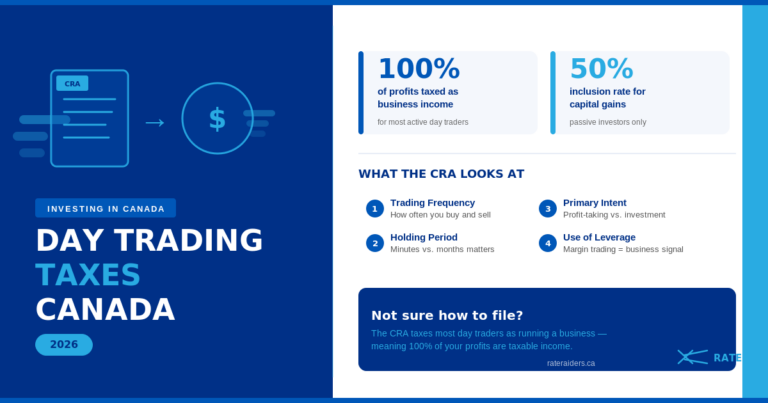
The short version: Most day traders in Canada pay income tax on their profits — not capital gains tax. The CRA’s position is that frequent, active trading constitutes carrying on a business, meaning 100% of your net profit is included in your taxable income.
By contrast, a casual investor who sells a stock after holding it for months would pay capital gains tax, where only 50% of the gain is included as taxable income (the capital gains inclusion rate).
How the CRA decides which category you’re in:
The CRA uses several factors to determine whether trading activity constitutes a business:
– How frequently you trade
– How long you hold positions before selling
– Your stated intention when buying
– Your level of knowledge and time devoted to trading
– Whether you use leverage or borrowed money
There’s no bright-line rule, but daily trading almost always triggers business income treatment. For a full breakdown of the rules and how to file, see our guide to day trading taxes in Canada.
TFSA day trading: The CRA has audited and reassessed TFSA accounts it deems to be operating as businesses. If your TFSA shows extremely high trading frequency and rapid profit-taking, your tax-free gains can be reassessed as business income. The risk is real — several Tax Court of Canada cases confirm it.
Best Platforms for Day Trading in Canada
Choosing the right platform is one of the most consequential decisions a Canadian day trader makes. Fees, order execution speed, charting tools, and account minimums vary significantly between providers.
Here’s a quick comparison of the top platforms Canadian day traders use:
| Platform | Commission | Min. Deposit | Best For |
|---|---|---|---|
| Questrade | $4.95–$9.95/trade (stocks) | $1,000 | Active traders wanting low fees |
| Wealthsimple Trade | $0 (Plus plan) | $0 | Beginners; casual traders |
| TD Active Trader | $0 (with 150+ trades/quarter) | None stated | High-volume active traders |
| Interactive Brokers Canada | $0.005/share (min $1) | $0 | Professional-grade tools |
| OANDA Canada | Spread-based | $0 | Forex day trading |
For a full ranked comparison with pros and cons, see our guide to the best day trading platforms in Canada.
Day Trading Rules in Canada
Beyond tax treatment, Canadian day traders need to be aware of several regulatory rules:
IIROC (now CIRO) regulations: The Canadian Investment Regulatory Organization oversees all investment dealers and trading activity in Canada. All Canadian brokerages are CIRO-regulated.
Margin accounts: Day trading on margin (borrowed money) is permitted in Canada and is commonly used by active traders. Margin rates and requirements vary by brokerage.
Short selling: Short selling is legal in Canada through margin accounts. Most major Canadian brokerages offer it for stocks listed on major exchanges.
Pattern day trading: As noted, Canada has no equivalent to the U.S. PDT rule. You can make as many intraday trades as you want regardless of account size.
For a detailed breakdown of CRA definitions, TFSA rules, and what “pattern day trading” means in a Canadian context, read our full guide to day trading rules in Canada.
How to Start Day Trading in Canada: A Step-by-Step Overview
Starting day trading in Canada involves five concrete steps:
Step 1 — Choose your market and instrument. Most Canadian beginners start with stocks on the TSX or U.S. markets. Options and forex carry higher risk and require more knowledge.
Step 2 — Open a brokerage account. For day trading, you want a non-registered account (not a TFSA or RRSP, for the reasons outlined above). Select a platform with fast execution and competitive commissions.
Step 3 — Fund your account. Most platforms require at least $1,000 to start, though some (like Wealthsimple Trade) have no minimum.
Step 4 — Paper trade first. Most serious platforms offer paper trading (simulated trading with fake money). Use it to build a strategy before risking real capital.
Step 5 — Start small and track everything. Keep a trading journal. Record your entry and exit prices, the rationale behind each trade, and your outcome. Consistent self-review is what separates sustainable traders from one-time losses.
For a complete walkthrough designed for beginners, including platform setup and risk management, see our guide to day trading for beginners in Canada.
Day Trading in a TFSA: What You Need to Know
The TFSA is one of Canada’s most powerful investment accounts — but it’s not designed for day trading.
The CRA’s position is that TFSAs are meant for passive investing. If a TFSA is being used to carry on a business — and active day trading can qualify — the CRA can deem the income taxable. Several Tax Court of Canada decisions since 2015 have upheld this position.
The practical rule: hold long-term positions in your TFSA. Keep your active trading in a taxable non-registered account where losses are also deductible.
Day trading in an RRSP carries similar risks. RRSP withdrawals are fully taxable as income, which means trading gains don’t benefit from the capital gains rate anyway — and if the CRA deems the account a business, you lose the tax shelter entirely.
Day Trading vs. Swing Trading vs. Investing in Canada
| Strategy | Holding Period | Tax Treatment | Risk Level |
|---|---|---|---|
| Day trading | Minutes to hours | Business income (typically) | High |
| Swing trading | Days to weeks | Business or capital (depends on frequency) | Medium–High |
| Long-term investing | Months to years | Capital gains (50% inclusion) | Lower |
Most Canadians are better served by long-term investing or a hybrid approach. Day trading requires significant time, discipline, and capital — and the majority of retail day traders lose money in the first year.
That said, for those who treat it seriously — with a strategy, risk management rules, and proper tax accounting — day trading can be a legitimate income source.
Frequently Asked Questions
Is day trading profitable in Canada?
Some day traders are consistently profitable, but most retail traders lose money, especially in the first year. Studies of retail trading accounts suggest roughly 70–80% of retail day traders lose money over a 12-month period. Success requires a tested strategy, strict risk management, and ongoing discipline.
Do I need a licence to day trade in Canada?
No. You don’t need a licence to trade your own money in Canada. A licence (such as the Chartered Investment Manager designation) is only required if you’re trading on behalf of others.
How are day trading profits taxed in Canada?
The CRA typically treats day trading profits as business income — meaning 100% of net gains are added to your taxable income. Capital gains tax (50% inclusion rate) generally applies to casual investors, not active day traders. Consult a tax professional for advice specific to your situation.
Can I day trade in my TFSA?
Technically yes, but the CRA can reassess your TFSA gains as taxable business income if it determines your account is being operated as a business. Active day traders should use a non-registered account.
What’s the best platform for day trading in Canada?
Questrade and TD Active Trader are the most popular among active Canadian traders. Questrade offers low commissions starting at $4.95/trade; TD Active Trader offers $0 commissions for traders who make 150+ trades per quarter. See our full comparison of the best day trading platforms in Canada.
Is day trading forex legal in Canada?
Yes. Forex trading is legal in Canada and is regulated by CIRO. Canadian forex traders should use brokers registered with CIRO — platforms like OANDA Canada and Interactive Brokers Canada are common choices. For a full comparison, see our guide to the best forex brokers in Canada.