Day Trading Rules Canada: CRA Pattern Rules & Regulations (2026)
Canada’s day trading rules differ significantly from the US — there’s no pattern day trader rule and no minimum account balance. But the CRA has its own criteria for classifying traders, TFSA rules are strict, and margin accounts carry their own requirements. Here’s everything that applies to Canadian traders.
Canada’s day trading rules are simpler than the U.S. equivalent — but they’re not toothless. The rules you need to know aren’t in a single regulation. They’re spread across CRA guidance, CIRO rules, and the Income Tax Act, and getting them wrong has real tax and legal consequences.
Here’s what every Canadian day trader needs to understand before placing a trade.
Is Day Trading Legal in Canada?
Day trading is legal in Canada for any individual trading their own money. You don’t need a licence, registration, or approval from a regulator to day trade a personal account.
What does require licensing is trading on behalf of others — managing client portfolios, operating a fund, or executing trades for third parties. That falls under CIRO’s (Canadian Investment Regulatory Organization) jurisdiction and requires registration as an investment adviser or portfolio manager.
For self-directed retail day traders using a standard brokerage account, there are no legal restrictions on the activity itself.
Does Canada Have a Pattern Day Trader Rule?
Canada vs. USA: Day Trading Rules
General information only — not legal or tax advice | rateraiders.ca
No. The U.S. Financial Industry Regulatory Authority (FINRA) requires traders who make four or more day trades within five business days to maintain at least US$25,000 in their account — this is the “pattern day trader” (PDT) rule. Canadian regulators (CIRO) do not have an equivalent rule.
Canadian retail traders can make unlimited intraday trades regardless of their account size. There is no minimum balance requirement linked to trading frequency.
This is one of Canada’s genuine advantages for retail day traders. A Canadian with a $5,000 account can execute 20 intraday trades in a single day without any regulatory restriction. An American in the same situation would need to maintain $25,000 USD or face trading restrictions.
CRA’s Definition of Day Trading
The CRA doesn’t define “day trading” with a single rule — instead, it applies a facts-and-circumstances test to determine whether a trader is carrying on a business.
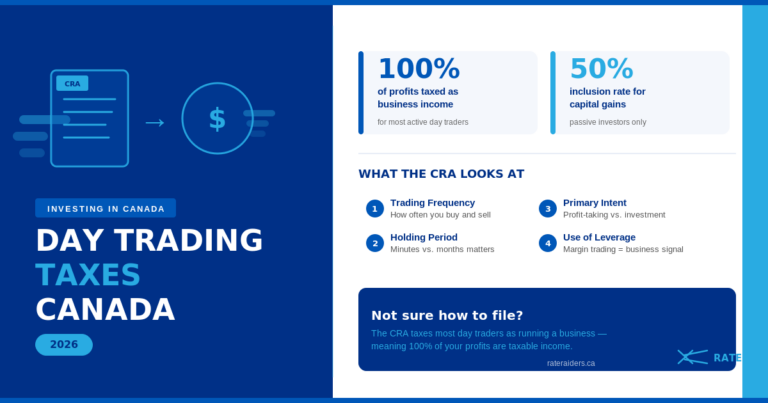
Under the CRA’s framework (outlined in Interpretation Bulletin IT-479R), the key factors are:
Frequency: How often do you trade? Daily or multiple-times-per-day trading is a strong indicator of business activity.
Holding period: How long do you hold positions? Minutes or hours (versus months or years) signals speculative rather than investment intent.
Primary intent: Did you buy with the intention of reselling quickly at a profit? If yes, that indicates business income.
Knowledge and expertise: Do you study technical analysis, follow market data, and devote professional-level time to trading? The CRA takes this into account.
Use of leverage: Trading on borrowed money (margin) is another indicator the CRA uses to classify activity as business-like.
The practical outcome for most active day traders: the CRA will treat your gains as business income, taxable at 100% of your marginal rate — not as capital gains, which benefit from a 50% inclusion rate. For the full tax breakdown, read our guide to day trading taxes in Canada.
Day Trading Rules for TFSAs
The Tax-Free Savings Account is one of Canada’s most powerful investment vehicles — but it comes with rules that active traders must respect.
What’s allowed: Buying and holding eligible investments, including stocks, ETFs, GICs, bonds, and mutual funds. Selling positions and reinvesting proceeds is fine.
What triggers CRA risk: High-frequency buying and selling inside a TFSA. The CRA’s position is that a TFSA is meant for passive investment — not for operating a trading business. If the CRA determines your TFSA is being used to carry on a business, it can:
- Declare the TFSA income taxable (retroactively removing the tax-free status)
- Assess income tax plus arrears interest and potential penalties
Several Tax Court of Canada decisions since 2015 have upheld the CRA’s right to do this. In one notable case, a Halifax trader had his TFSA reassessed on over $600,000 in trading profits after the CRA determined the account was being run as a business.
The practical rule: Use your TFSA for long-term investing. Day trade in a non-registered account.
What is considered day trading in a TFSA? The CRA hasn’t set a hard threshold. Relevant factors include: trading frequency, how quickly you turn over positions, whether you’re using leverage, and whether your trading patterns mirror those of a professional. A person who makes 5–10 trades per year is unlikely to attract CRA attention. A person making dozens of trades per week almost certainly will.
TFSA Day Trading Rules: What You Can and Can’t Do
TFSA Day Trading Rules
Source: CRA Interpretation Bulletins | rateraiders.ca | Not tax advice — consult a professional
| Activity | TFSA Status |
|---|---|
| Buy and hold stocks long-term | ✅ Permitted |
| Sell a position and reinvest proceeds | ✅ Permitted |
| Trade stocks weekly (moderate frequency) | ⚠️ Grey area — depends on overall pattern |
| Daily intraday trading | ❌ High CRA risk |
| Margin trading inside a TFSA | ❌ Not permitted (TFSAs cannot hold margin positions) |
| Short selling inside a TFSA | ❌ Not permitted |
RRSP Day Trading Rules
Registered Retirement Savings Plans have a similar risk profile. The CRA can reassess RRSP gains as taxable income if it determines the account is being used to carry on a business.
Beyond CRA risk, there’s a second reason to avoid day trading inside an RRSP: RRSP withdrawals are fully taxed as income regardless of how the money was earned. Day trading gains inside an RRSP would be taxed at your full marginal rate on withdrawal — the same treatment as business income in a non-registered account, but with the added restriction that losses can’t be deducted.
Margin Trading Rules in Canada
Margin trading — using borrowed money from your brokerage to increase your buying power — is legal in Canada for non-registered accounts. Key rules:
Margin eligibility: Most CIRO-regulated brokerages allow margin accounts for clients who meet suitability requirements.
Typical margin rates: 30–50% margin requirement for most Canadian equities, meaning you must maintain at least 30–50 cents of equity for every dollar of position.
Margin calls: If your account equity falls below the required margin level, your brokerage can issue a margin call requiring you to deposit more funds or close positions.
Margin trading amplifies both gains and losses. It’s a tool for experienced traders — not a strategy for beginners.
Short Selling Rules in Canada
Short selling — borrowing and selling shares you don’t own, with the intention of buying them back at a lower price — is legal in Canada and is available through margin accounts at most major brokerages.
Specific rules vary by brokerage. Questrade, Interactive Brokers Canada, and TD Active Trader all offer short selling for eligible accounts. Wealthsimple Trade does not currently support short selling.
Frequently Asked Questions
Is day trading legal in Canada?
Yes, day trading is legal for individuals trading their own money. No licence or registration is required for self-directed retail trading.
Does Canada have a pattern day trader rule?
No. Canada has no equivalent to the U.S. PDT rule. Canadian traders can make unlimited intraday trades regardless of account size.
What is considered day trading in Canada?
The CRA defines day trading broadly based on factors including trading frequency, holding periods, and intent. Generally, any strategy that involves buying and selling securities within the same day — or holding for very short periods with the intent to profit from price movements — qualifies.
Can I day trade in my TFSA?
Technically yes, but the CRA can reassess your TFSA gains as taxable business income if it determines the account is being used to carry on a business. Active day traders should use a non-registered account.
Is day trading self-employment in Canada?
If the CRA classifies your activity as carrying on a business, you report trading income as self-employment income on T2125. You’re not an employee — you don’t pay EI premiums — but you do pay income tax on 100% of profits and may owe Canada Pension Plan contributions on self-employment income.