Day Trading for Beginners Canada: Step-by-Step Starter Guide (2026)
Most beginners lose money because they skip the fundamentals — not because the market is against them. This step-by-step guide covers everything a Canadian needs before placing their first trade: account types, platform selection, paper trading, risk management, and how much capital to start with.
Most people who try day trading lose money in their first year. Not because day trading is impossible — it isn’t — but because most beginners skip the foundation and start trading real money before they’re ready.
Starting the right way is straightforward. It’s not exciting, and it doesn’t feel like trading. But it’s what separates the traders who last from the ones who quit.
Here’s the honest beginner’s guide to day trading in Canada.
What You Need to Know Before You Start
Day trading is legal in Canada, accessible through several low-cost platforms, and possible with modest capital. But three realities are worth internalising before you open an account:
Most retail day traders lose money. Studies of retail trading accounts consistently show that 70–80% of retail traders lose money over their first year. The losses aren’t random — they follow predictable patterns: overtrading, poor risk management, and trading without a tested strategy.
The CRA taxes day trading as business income. Your day trading profits are almost certainly taxed at your full marginal rate — not at the 50% capital gains inclusion rate that casual investors enjoy. For a full breakdown, read our guide to day trading taxes in Canada.
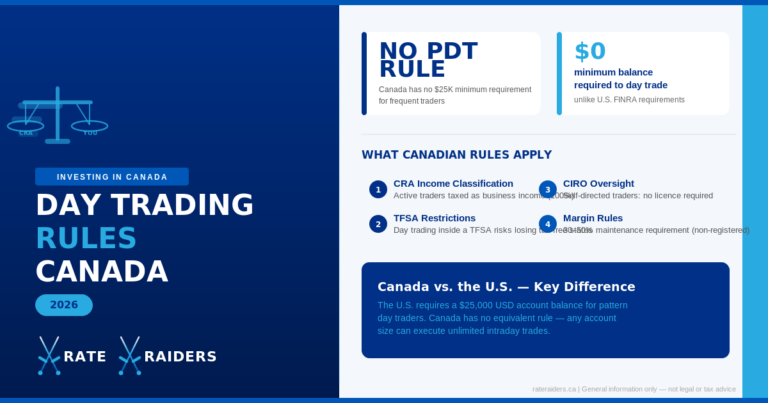
You don’t need a lot of capital to start — but you need a strategy. Unlike the U.S., Canada has no pattern day trader (PDT) rule requiring a minimum $25,000 account. You can start with $1,000 or less. The challenge isn’t the starting amount — it’s developing a repeatable edge.
Step 1: Understand the Basics of How Markets Work
Before you place a trade, you need to understand the mechanics:
What moves stock prices: Supply and demand, earnings reports, economic data, sector news, and broader market sentiment all affect stock prices. Intraday traders react to these catalysts in real time.
Order types: A market order buys or sells at the current best available price. A limit order only executes at your specified price or better. A stop-loss order automatically sells if price drops to a threshold you set. Knowing these isn’t optional — placing the wrong order type in a fast market can be expensive.
Bid-ask spread: The difference between what buyers will pay (bid) and what sellers will accept (ask) is the spread. On liquid stocks, spreads are often just a cent or two. On thinly traded stocks, spreads can be significant and represent an immediate cost to every trade.
Level 2 quotes: Level 2 data shows the full order book — who is buying and selling, at what prices, and in what quantities. Most active traders rely on Level 2 for intraday decisions.
Step 2: Choose the Right Account Type
For day trading in Canada, you want a non-registered (taxable) account. Not a TFSA, not an RRSP.
The reason: the CRA can deem active day trading inside a TFSA or RRSP as business activity, retroactively removing the tax shelter and assessing the full income as taxable. Active traders should keep their trading in a taxable account, where business losses are also deductible.
Non-registered accounts are available at every major Canadian brokerage. They have no contribution limits and no restrictions on trading frequency.
Step 3: Choose a Brokerage Platform
Your brokerage platform is your primary tool. For beginners, these are the most sensible starting points:
Questrade is the most popular choice for new-to-intermediate Canadian day traders. Commission costs are $4.95–$9.95 per trade, the minimum deposit is $1,000, and the Questrade Trading platform covers the tools most beginners need: real-time data, limit and stop orders, and watchlists. For a detailed review, see our Questrade day trading review.
Wealthsimple Trade charges no commission on Canadian stocks and ETFs and has no minimum deposit. For a complete beginner who wants to test trading mechanics without committing to fees, Wealthsimple is a logical entry point — but the platform has fewer order types and tools than Questrade. For what Wealthsimple can and can’t do for day traders, read our breakdown: Can You Day Trade on Wealthsimple?
TD Active Trader is powerful but best suited to traders who are already executing 150+ trades per quarter. As a beginner, you won’t hit that threshold, so the $7.00 per-trade rate is less competitive than Questrade.
For a side-by-side comparison, see the best day trading platforms in Canada.
Step 4: Paper Trade Before Using Real Money
Paper trading — simulated trading with fake money in real market conditions — is the single most underused tool among beginner day traders.
Most major platforms offer a paper trading or demo mode. Questrade’s IQ Edge platform includes a paper trading function. Many dedicated trading simulators (like Investopedia’s Stock Simulator) are also free to use.
Minimum paper trading period for beginners: 30 trading days. Long enough to see your strategy tested across different market conditions — trending days, flat days, high-volatility days.
What to track during paper trading:
– Your win rate (what percentage of trades close profitably)
– Your average win vs. average loss (your “risk-reward ratio”)
– The conditions under which your strategy works and fails
– How many trades you make per day
If your paper trading results aren’t profitable over 30 days, don’t start trading real money. Refine the strategy.
Step 5: Build a Simple Trading Strategy
A day trading strategy is a repeatable set of rules that tells you when to enter a trade, when to exit profitably, and when to cut a loss.
Common beginner-friendly strategies used by Canadian day traders:
Momentum trading: Buy stocks that are moving significantly on high volume in the first 30–60 minutes of market open, with a clear catalyst (earnings, news). Exit when momentum stalls.
Opening range breakout: Identify the high and low of the first 15 or 30 minutes of trading. Enter when price breaks decisively above the high or below the low, with a stop-loss just inside the range.
Trend following: Trade in the direction of the prevailing trend on your chosen timeframe. Avoid trading against the trend.
The strategy matters less than having one and following it consistently. The most common cause of beginner losses is abandoning strategy in the moment — chasing stocks, holding losers too long, or over-sizing positions after a big win.
Step 6: Manage Risk on Every Trade
Risk management is what separates traders who survive from those who blow up their accounts. Three non-negotiable rules:
Risk no more than 1–2% of your account on any single trade. If you have a $5,000 account, your maximum loss per trade should be $50–$100. This keeps one bad trade from derailing your progress.
Set a stop-loss before you enter. Know your exit point before you get in. A stop-loss at a specific price level removes the emotional decision-making from the moment when it’s hardest to think clearly.
Set a daily loss limit. Many professional traders stop for the day if they lose 2–3% of their account in a single session. Bad days happen — the discipline is not letting one bad day become a catastrophic one.
Step 7: Track and Review Every Trade
A trading journal is one of the highest-leverage habits a day trader can build. Record:
– Date and time of entry and exit
– The stock or instrument traded
– Your reason for entering (the setup)
– Entry price, exit price, stop-loss level
– Profit or loss in dollar terms
– What you did well and what you’d change
Reviewing your journal weekly identifies patterns: which setups work, which markets you perform better in, and where your emotional decision-making is costing you money.
How Much Money Do You Need to Start Day Trading in Canada?
There’s no regulatory minimum — Wealthsimple Trade has no minimum deposit, and Questrade requires only $1,000. But the practical answer depends on your strategy and commission structure.
With $1,000–$5,000: Commissions represent a larger percentage of each trade. Focus on low-commission platforms (Wealthsimple Trade or Questrade’s higher-volume tiers). At this level, risk management is especially critical — one bad position can represent a significant portion of your account.
With $10,000–$25,000: You have more flexibility to absorb losses while you develop your skills, and commissions become less impactful as a percentage of trade size.
Starting with more capital isn’t an advantage if you haven’t developed your strategy first. Many experienced traders recommend proving out your system on paper or with small amounts before scaling up.
Frequently Asked Questions
Can I start day trading in Canada with no experience?
Yes — but you should paper trade first. The mechanics of placing trades are simple; building a profitable strategy takes time, observation, and iteration.
How do I learn day trading in Canada?
Start with free resources: Investopedia’s day trading section covers concepts clearly. YouTube channels focused on Canadian markets exist but vary in quality. Avoid any course promising specific returns — legitimate education focuses on concepts, not guarantees.
Is day trading good for beginners?
Day trading is high-risk and time-intensive. Most beginners are better served by starting with long-term investing, then adding active trading incrementally as they develop skills and strategy. If you’re committed to learning day trading, paper trade for at least 30 days before using real money.
What is the best stock for day trading in Canada?
Liquid stocks with high average daily trading volume and clear price action are generally easiest for beginners. On the TSX, this often means large-cap stocks in mining, energy, and financials. U.S. stocks accessible through Canadian brokerages offer even more liquidity.
How do I become a day trader in Canada?
Open a non-registered brokerage account, fund it, and start paper trading. Develop a tested strategy, then begin trading small positions with strict risk management. It’s a skill — not a product you buy.